You are using an outdated browser. Please upgrade your browser to improve your experience and security.

Skip to main
Blog

Practicing Self-Care, Step-by-Step

BY: Trevor News
Donate

If you find yourself feeling exhausted, overwhelmed, or just “off,” you’re not alone. Everyone needs to take care of themselves, even if it’s just enjoying a quick snack or doing simple breathing exercises. Self-care is essential, but it can be challenging to make time for it. And if you struggle with your mental health, it can be even tougher to make self-care a part of your routine.

To make self-care a little easier, we made a guide that will take you step-by-step through different forms of self-care. You don’t have to follow it to the letter, but we hope this guide brings you comfort and reminds you to nourish your body and mind!
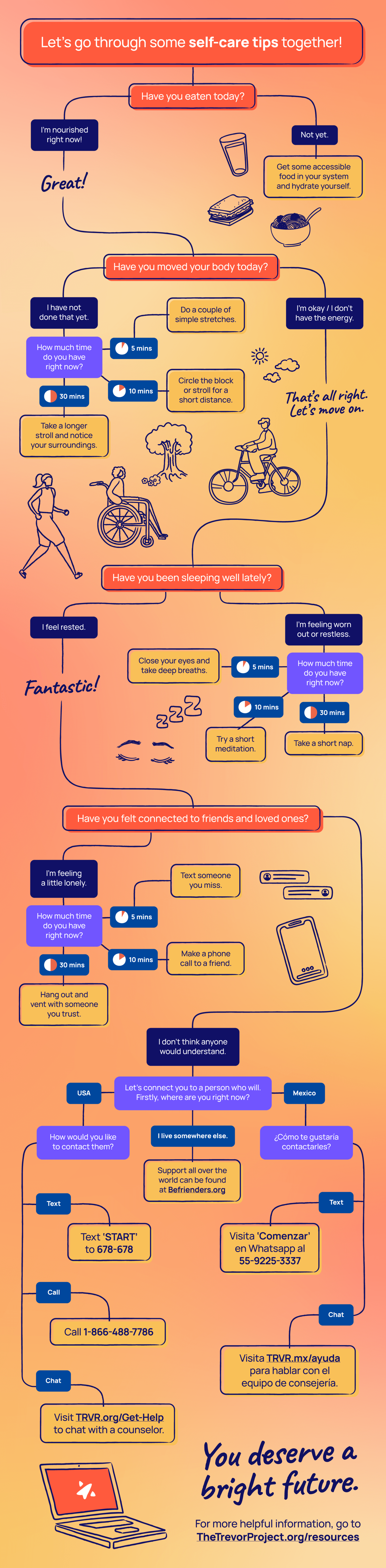
Flowchart that details step-by-step different techniques for emotional regulation and self-care, like preparing a small snack, taking a walk, and reaching out to The Trevor Project.

Read more from
Blog

Blog

“What They’re Doing Is Not Therapy”: Conversion Therapy Survivors Speak Out

Jump to VideoWhen Andrew came out to his parents at fourteen, neither of them responded with acceptance. Instead, they arranged for Andrew to see a therapist who promised to “fix” his sexual orientation.  “If me being straight was how I got their love and acceptance, I was like okay, I guess I’ll go,” he remembers. What Andrew didn’t realize at the time was that he was about to be subjected to a dangerous practice called conversion therapy.  There, Andrew was told that “there was something wrong with me for having these thoughts,” and instructed to suppress them. “I call it…
An illustration of 2 LGBTQ+ young people standing together. One person has their hand on the other person's shoulder.
Blog

Rural Health: Breaking down the data. What does the 2025 U.S. National Survey say about LGBTQ+ young people living in rural areas?

The Trevor Project’s 2025 U.S. National Survey on the Mental Health of LGBTQ+ Young People analyzed the experiences of more than 16,000 LGBTQ+ young people ages 13 to 24 across the United States. The survey covers an array of risk factors, protective factors, and day-to-day experiences that impact LGBTQ+ young people’s mental health and well-being. This blog post offers a deeper dive into the data – and offers a breakdown of what the 2025 U.S. National Survey reveals about the experiences of LGBTQ+ young people living in rural areas. What is a rural area and why does it matter for…