Youth's Lives Every Day
Key Findings
- Among transgender and nonbinary young people, nearly a third (32%) used binary pronouns (“he/him” or “she/her”), 26% used a combination of binary and nonbinary pronouns (“he/they” or “she/they”), and 15% used nonbinary pronouns (“they/them”).
- Among transgender and nonbinary young people who used another pronoun to describe themselves, the most commonly used pronouns were “it/its” and variations of “xi/xe” and “zi/ze.”
- Transgender boys/men (52%) and transgender girls/women (48%) reported higher levels of pronoun respect than those questioning their gender (40%) and nonbinary young people (37%).
- TGNB young people whose pronouns were respected had lower rates of past-year suicide attempts (11%) compared to those whose pronouns were not respected (17%), being associated with 31% lower odds of a past-year suicide attempt.
Background
The use and respect of one’s pronouns are essential components of gender identity expression and affirmation for transgender and nonbinary (TGNB) young people.1 As gender diversity becomes increasingly recognized,2 some TGNB young people are beginning to adopt pronouns outside of the more well-known binary categories (i.e., he/him and she/her).3 These pronouns can include they/them or combinations of multiple pronouns such as she/they and he/they, often referred to as nonbinary pronouns. TGNB people may also use other pronouns, sometimes referred to as neopronouns, such as it/its, xe/xi, or ze/zi to express their gender identity.2-4 People may adopt nonbinary and neopronouns for a variety of reasons, ranging from a desire for language to reflect their individual gender identities to expanding the concept of gender to be more inclusive.5 Importantly, when others respect their pronouns, TGNB people report greater well-being,6 and lower rates of anxiety,7 psychological distress,8 and past-year suicide attempts.9 However, among TGNB young people, less is known about how pronoun respect may vary depending on the specific pronouns used. Understanding pronoun identification — and the degree to which they are respected — can inform education and intervention efforts aimed at improving pronoun respect, which may in turn impact the mental health of TGNB young people. Using data from The Trevor Project’s 2024 U.S. National Survey on the Mental Health of LGBTQ+ Young People, this brief examines pronoun usage and pronoun respect among TGNB young people.
Results
Among TGNB young people, approximately one-third (32%) reported exclusively using binary pronouns (he/him or she/her) and 68% reported using nonbinary (they/them), a combination of binary and nonbinary (he/they or she/they), or other pronouns to express their gender. More specifically, 19% reported using he/him pronouns, 13% she/her, 15% they/them, 13% he/they, 13% she/they, 17% all/any pronouns, and 10% another pronoun. Please see the Methods section for a detailed description of pronoun categorization.

Those who selected “another pronoun” (10% of the sample) had the option of specifying their pronouns. The most frequently mentioned were: it/its, variations of xe/xi (xe, xem, xer; xi, xim, xir), and variations of ze/zi (ze, zem, zer; zi, zim, zir). Collectively, these pronouns accounted for over half (57%) of these responses. Other responses included: “any pronouns” or “any neopronouns”; “any pronouns except [a specific pronoun]”; changing pronouns (e.g., fluid); “no pronouns” (preferring to be called by name); nounself pronouns (adapting a noun into a pronoun); and a variety of other specific pronouns (e.g., aer, fae, em).
Less than half (46%) of TGNB young people reported that a lot or most/all of the people in their lives respected their pronouns. Levels of pronoun respect varied by pronoun use. For example, TGNB young people who used binary pronouns reported higher levels of pronoun respect (62%) than their peers who used a combination of binary and nonbinary pronouns, nonbinary pronouns exclusively, or other pronouns (38%).

Rates of pronoun respect varied by demographic groups. Older (ages 18-24) TGNB young people were more likely to report pronoun respect (51%) than TGNB young people ages 13-17 (40%). Middle Eastern/North African (57%) and White (48%) TGNB young people reported higher rates of pronoun respect than other racial/ethnic groups. Heterosexual (66%) and gay (53%) TGNB young people were more likely to report pronoun respect than those of other sexual orientations. Finally, transgender boys/men (52%) and transgender girls/women (48%) reported greater rates of pronoun respect than those questioning their gender (40%), as well as nonbinary individuals (37%).
Pronoun respect was related to past-year suicide attempts. TGNB young people who reported experiencing pronoun respect reported significantly lower rates of a past-year suicide attempt (11%) compared to their peers who did not report pronoun respect (17%). Rates of past-year suicide attempts decreased per level of pronoun respect, as well (see chart). After controlling for demographic and other relevant factors, pronoun respect was associated with 31% lower odds of a past-year suicide attempt (aOR = 0.69, 95% CI = .60, .78, p < .001) compared to those who did not experience pronoun respect.

Looking Ahead
These findings underscore a pressing need to increase pronoun respect for TGNB young people, as it represents a core expression of affirmation, dignity, and recognition of their humanity. We found that less than half of TGNB young people reported that they experienced pronoun respect from a lot or most/all of the people in their lives, with even lower levels among those who used a combination of binary and nonbinary pronouns, nonbinary pronouns exclusively, or other pronouns to express their gender. Additionally, pronoun respect varied by demographic groups, including age, sexual orientation, race/ethnicity, and gender identity, with transgender boys/men and girls/women reporting higher levels of pronoun respect than their nonbinary and questioning peers. These findings are especially important because pronoun respect was associated with lower odds of attempting suicide in the past year, which has also been found in past research.9
Future work is needed to expand understanding of barriers to pronoun respect, particularly for TGNB young people who do not use binary pronouns exclusively. Some TGNB youth shared using pronouns that are not widely known. Peers, adults, caregivers, and professionals may lack familiarity and understanding of these pronouns, which could lead to unintentional misgendering or using the wrong pronouns. While becoming familiar with all pronouns may not be feasible, we recommend building broader awareness and appreciation of diverse pronoun identities and following the lead of young people when they share their pronouns.
Promoting inclusive practices across settings (e.g., digital platforms, schools, health care spaces, home, and peer spaces) can help create environments where TGNB young people’s pronouns and identities are respected. Increasing cultural humility, providing inclusive training, and normalizing the sharing and asking of pronouns are practical steps that can help affirm TGNB young people’s identities and reduce harm. Future research can further identify what facilitates or hinders correct and consistent pronouns use, as well as explore how factors such as culture, geography, political affiliation, and religiosity may influence pronoun respect. Continued investigation of how pronoun respect relates to mental health and suicide risk will also be essential for developing targeted interventions that support TGNB young people.
All TGNB young people deserve to feel safe and affirmed in their pronouns and gender identities. Our TrevorSpace platform is a safe and supportive online space for LGBTQ+ young people between the ages of 13 to 24 years. On TrevorSpace, LGBTQ+ youth can make friends, explore their pronouns and identity, and find support in a moderated online community specifically designed for LGBTQ+ youth. Our free, 24/7 crisis services are committed to make sure that all LGBTQ+ young people are provided high-quality crisis care. In order to best serve LGBTQ+ youth callers, we have a diverse team of crisis counselors that align with the demographics of the LGBTQ+ young people we serve, who will consistently respect the caller’s name and pronouns. Finally, our Research team is committed to the ongoing dissemination of research related to TGNB identities and pronouns to help make sure that all TGNB youth can feel seen, safe, and respected.
To read more on this topic, check out our research brief, Pronouns Usage Among LGBTQ Youth, as well as an article on Understanding Gender Identities & Pronouns.
Data Tables
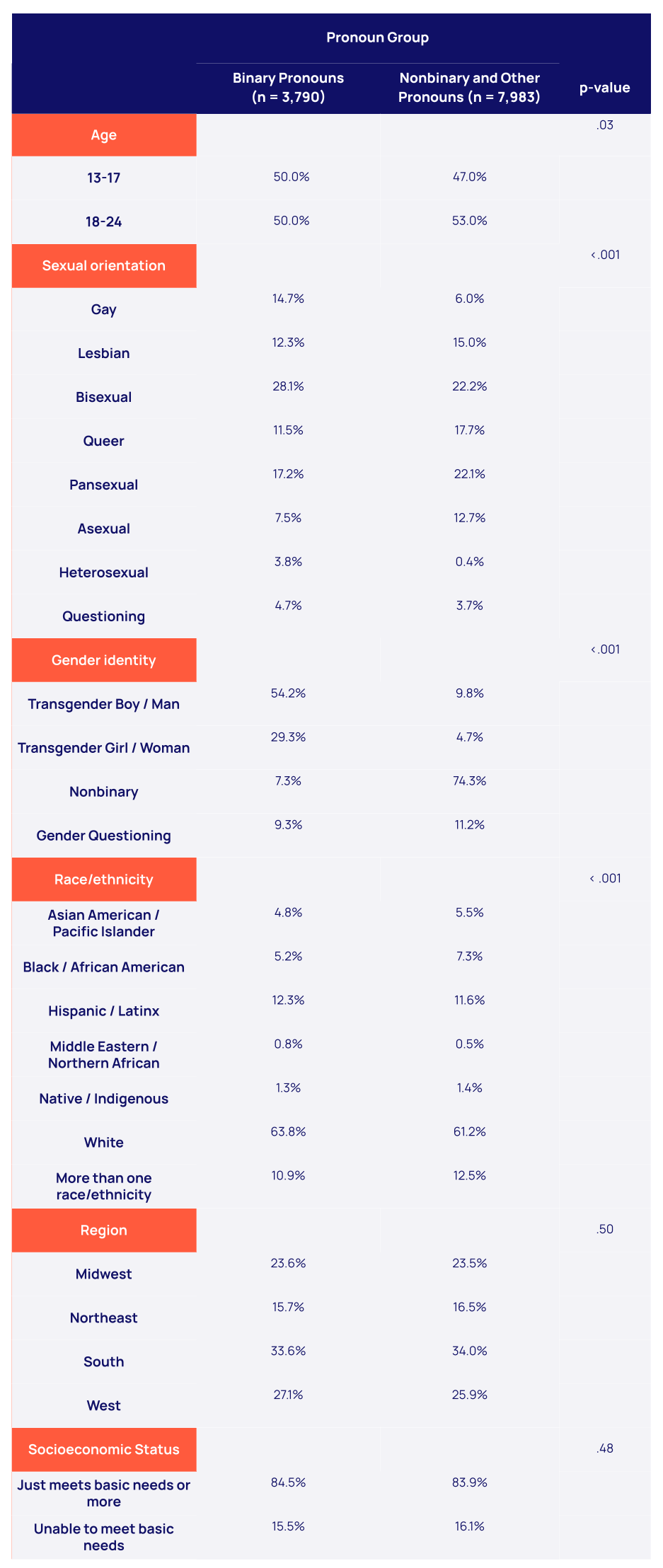
Demographic Characteristics of TGNB Young People Who Use Binary vs. Nonbinary and Other Pronouns
Methods
References
Recommended Citation
The Trevor Project (2025). Pronoun Usage and Mental Health Impacts of Pronoun Respect in TGNB Young People. https://doi.org/10.70226/KTUU7547
For more information please contact: [email protected]
© The Trevor Project 2025