- Who We Are
- What We Do
- Crisis ServicesWe provide counseling support for LGBTQ+ young people 24/7, all year round
- Peer SupportWe provide an affirming international community for LGBTQ+ young people
- AdvocacyWe work to change hearts, minds, and laws in support of young LGBTQ+ lives
- Public EducationWe help allies and educators understand the needs of LGBTQ+ young people
- ResearchWe conduct research studies to equip policymakers and other LGBTQ+ youth-facing professionals
- Get Involved
- Support Us
- DonateSupport The Trevor Project Today
- FundraiseTap into your network and help us change the world
- Donor CommunityJoin the community of committed donors shining the way to our vision
- Commemorative GivingMake a tribute gift, leave a legacy, or create a memorial fundraiser in honor of a loved one
- StoreGet Trevor merch and show support for LGBTQ+ young people in your community
- Resources
- BlogRead about our community, supporters, and initiatives
- Media & CreatorsFind the latest news to support your coverage and content
- Research BriefsGet the latest research and clinical implications related to LGBTQ+ youth and suicide risks
- Breathing ExerciseTry this calming exercise that will help you relax and focus
- Mental Health SurveyUnderstand the mental health of LGBTQ+ young people
- Resource CenterExplore resources for allyship, sexual orientation, gender identity, mental health, and many more
Project SPARK Two-Year Findings: A Longitudinal Study of Protective and Risk Factors in LGBTQ+ Youth Mental Health
Background
Project SPARK's study rationale, study design overview, methodology, and timeline.

Study Rationale
LGBTQ+ young people face disproportionate mental health challenges, including elevated rates of poor mental health, suicidal thoughts, and suicide attempts compared to their cisgender heterosexual peers (Centers for Disease Control and Prevention [CDC], 2023; Veale et al., 2017). These disparities are not attributable to LGBTQ+ identity itself; rather, they result from chronic exposure to stigma, prejudice, and discrimination (Hatzenbuehler et al., 2010; Meyer, 2003). Although existing research has documented these disparities, much of the evidence comes from studies that capture young people’s experiences at a single point in time (Real & Russell, 2025). This limits what is known about how mental health, risk exposure, and sources of support change as LGBTQ+ youth move through adolescence and early adulthood. These gaps are especially important for transgender, nonbinary, and gender-questioning youth, whose developmental experiences and needs for affirming mental health care, transgender health care, and other supports remain underexamined.
Project SPARK (Studying Protective And RisK factors: A Longitudinal Mental Health and Experiences Study among LGBTQ+ Young People) was designed to address these gaps by following a large and diverse sample of LGBTQ+ young people over time. By collecting repeated data from the same participants, the study can examine how mental health trajectories unfold, which risk factors contribute to worsening outcomes, and which protective factors may support resilience and well-being. These findings can help inform evidence-based policies, resource allocation, clinical care, school-based supports, and community interventions for LGBTQ+ youth.
Throughout this report, the acronym “TGNB” is used to refer to participants who are transgender, nonbinary, or gender-questioning.
Study Design Overview
Project SPARK is an ongoing longitudinal study following 1,689 LGBTQ+ young people ages 13 to 24 from across the U.S. Participants are surveyed every six months about their mental health and well-being, experiences of discrimination and victimization, family and peer support, access to mental health care and transgender health care, and other lived experiences. This report presents two-year findings based on data from the first five waves of the study, collected from September 2023 through March 2026.*
*Note: This report reflects approximately two years of follow-up. Participants completed surveys every six months, but the exact calendar dates of participation varied depending on when each participant completed their baseline survey.
Methodology
Participant recruitment and eligibility: The study recruited U.S. residents ages 13 to 24 who self-identified as LGBTQ+ through paid social media advertisements. This occurred online during two recruitment windows: September 13 – December 12, 2023 and January 8 – February 17, 2024. Quota limits kept the baseline sample diverse by race/ethnicity and sex assigned at birth; once a quota was filled, additional entries from that group were closed. To be enrolled, respondents had to (1) provide electronic consent, (2) pass an honesty screen, and (3) submit unique email and phone information. Weekly reviews resolved possible duplicates or malicious responders, yielding a final analytic cohort of 1,689 participants.
Survey administration: To ensure accessibility and safety, data collection occurred via secure, confidential online surveys that included a maximum of 139 questions. All participant information was collected following strict ethical guidelines approved by an Institutional Review Board (IRB). Baseline and Wave 2 questionnaires were administered in the survey platform Qualtrics; Waves 3 to 5 were administered in the survey platform REDCap. Surveys were available in English and waves opened at six-month intervals.
Data analysis: This report of the two-year findings presents descriptive statistics and generalized linear mixed models. For descriptive results, “one-year follow-up” estimates summarize available data from Wave 2 and/or Wave 3, and “two-year follow-up” estimates summarize available data from Wave 4 and/or Wave 5. Specifically, for one-year follow-up estimates, we combined the 6-month recall windows used in the Wave 2 and Wave 3 surveys so that a “yes” response in either wave was indicative of exposure during the first 12-month follow-up period. For two-year follow-up estimates, we similarly combined available data from Waves 4 and 5 to summarize experiences across the second study year.
Descriptive results are presented only for participants with enough complete data across the study period for a given variable, including baseline data, data from at least one Wave 2 or Wave 3 survey to represent Year 1, and data from at least one Wave 4 or Wave 5 survey to represent Year 2. As a result, some baseline and one-year follow-up estimates in this two-year report may differ by a few percentage points from those presented in the interim one-year report published in October 2025, because the analytic sample for this report is restricted to participants with sufficient data across the two-year study period.
Because there was loss to follow-up across two years, observed changes could reflect attrition, meaning a change in the composition of the study population, rather than true change experienced by individual study participants. The most significant attrition occurred after the first wave; by Wave 5, 90% of study participants had completed at least one survey in each study year.
Generalized linear mixed models used data from all five available waves, controlling for the different recall window at baseline (i.e., 12 months), in order to examine the association of risk and protective factors on observed changes in anxiety, depression, suicidal ideation, self-harm, and suicide attempts. Models additionally controlled for age, sexual orientation, gender identity, and race/ethnicity. Because suicide attempts were relatively rare events during the first year of the study, statistical models examining changes in suicide attempts over time did not reliably converge and are not included in this report; we still report descriptive percentages for suicide attempts.
Unless otherwise noted, all analyses are statistically significant at p<0.05, meaning results as extreme as those observed would be expected less than 5% of the time if there were no true difference (i.e., under the null hypothesis). Due to rounding, some presented percentages may not precisely add up to reported totals.
Waves and Timeline
The following timeline summarizes the study’s progress. Throughout this report, we refer to Wave 1 as baseline, Wave 3 as the one-year follow-up, and Wave 5 as the two-year follow-up.
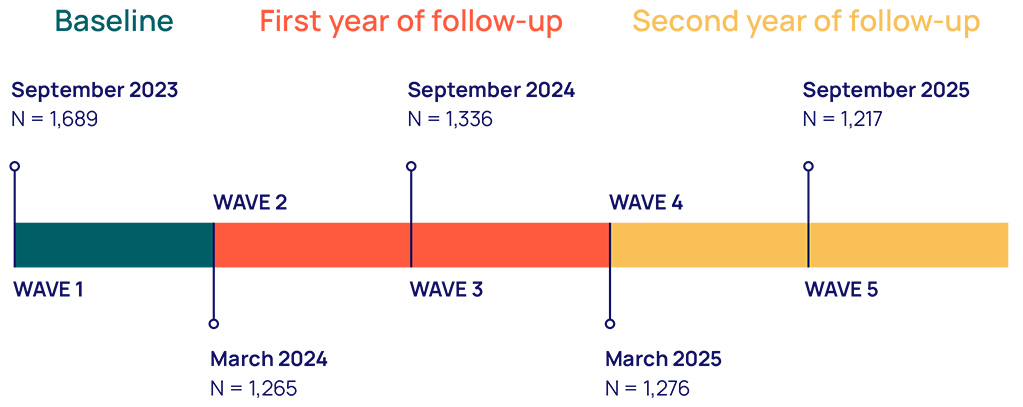
Table of Contents
Executive Summary
Background
Key Domains Measured
Results
• Demographics
• Changes in Mental Health Outcomes Over Time
• Changes in Risk Factors Over Time
• Changes in Protective Factors Over Time
• Temporal Relationships
Interpretations and Implications
Recommendations and Next Steps
References

Recommended Citation
Nath, R., Matthews, D.D., Hobaica, S., Eden, T.M., DeChants, J.P., Taylor, A.B., Suffredini, K. (2026). Project SPARK Two-Year Findings: A Longitudinal Study of Risk and Protective Factors in LGBTQ+ Youth Mental Health (2023-2026). West Hollywood, California: The Trevor Project. https://doi.org/10.70226/VFKG1732
For more information please contact: [email protected]
© The Trevor Project 2026