- Who We Are
- What We Do
- Crisis ServicesWe provide counseling support for LGBTQ+ young people 24/7, all year round
- Peer SupportWe provide an affirming international community for LGBTQ+ young people
- AdvocacyWe work to change hearts, minds, and laws in support of young LGBTQ+ lives
- Public EducationWe help allies and educators understand the needs of LGBTQ+ young people
- ResearchWe conduct research studies to equip policymakers and other LGBTQ+ youth-facing professionals
- Get Involved
- Support Us
- DonateSupport The Trevor Project Today
- FundraiseTap into your network and help us change the world
- Donor CommunityJoin the community of committed donors shining the way to our vision
- Commemorative GivingMake a tribute gift, leave a legacy, or create a memorial fundraiser in honor of a loved one
- StoreGet Trevor merch and show support for LGBTQ+ young people in your community
- Resources
- BlogRead about our community, supporters, and initiatives
- Media & CreatorsFind the latest news to support your coverage and content
- Research BriefsGet the latest research and clinical implications related to LGBTQ+ youth and suicide risks
- Breathing ExerciseTry this calming exercise that will help you relax and focus
- Mental Health SurveyUnderstand the mental health of LGBTQ+ young people
- Resource CenterExplore resources for allyship, sexual orientation, gender identity, mental health, and many more
Project SPARK Two-Year Findings: A Longitudinal Study of Protective and Risk Factors in LGBTQ+ Youth Mental Health
Results: Changes in Risk Factors Over Time
Observed changes in the rates of victimization, discrimination, experiences with conversion therapy, economic insecurity, and bathroom access over a two-year period.

Risk factors are experiences that can negatively affect the health and well-being of LGBTQ+ young people. In this section, we track key risk exposures reported over the first two years of the study, including victimization, discrimination, exposure to or threats of conversion therapy, economic insecurity (such as houselessness or not being able to meet basic needs), and lack of bathroom access among TGNB respondents.
Victimization
Physical threats based on sexual orientation: At baseline, 30% of participants reported being physically threatened because of their sexual orientation in the past year. This rate remained stable across the study period, with 30% reporting sexual orientation-based physical threats at the one-year follow-up and 31% reporting them at the two-year follow-up. These changes were not statistically significant.
Physical threats based on gender identity: Among TGNB participants, 38% reported being physically threatened because of their gender identity in the past year at baseline. This rate was essentially unchanged at the one-year follow-up (37%), but increased to 41% by the two-year follow-up. However, there was no significant change across the study period for gender identity-based physical threats among TGNB young people.
Discrimination
Rates of discrimination were high across the two-year study period, with more than half of participants reporting discrimination based on sexual orientation or gender identity at each time point.

Discrimination based on sexual orientation: At baseline, 56% of participants reported experiencing discrimination based on their sexual orientation in the past year. This decreased to 51% at the one-year follow-up, then rose again to 55% at the two-year follow-up. Overall, there was significant change across the study period; however, the two-year rate was not statistically different from baseline; sexual orientation-based discrimination returned to approximately its original level by the end of the second year.

Discrimination based on gender identity: Among TGNB participants, 57% reported experiencing discrimination based on their gender identity in the past year at baseline. This increased to 60% at the one-year follow-up and 67% at the two-year follow-up. Overall, there was significant change across the study period, with a statistically significant increase from the one-year to the two-year follow-up.
Conversion Therapy
Conversion therapy refers to any threat or attempt to change a young person’s sexual orientation or gender identity.
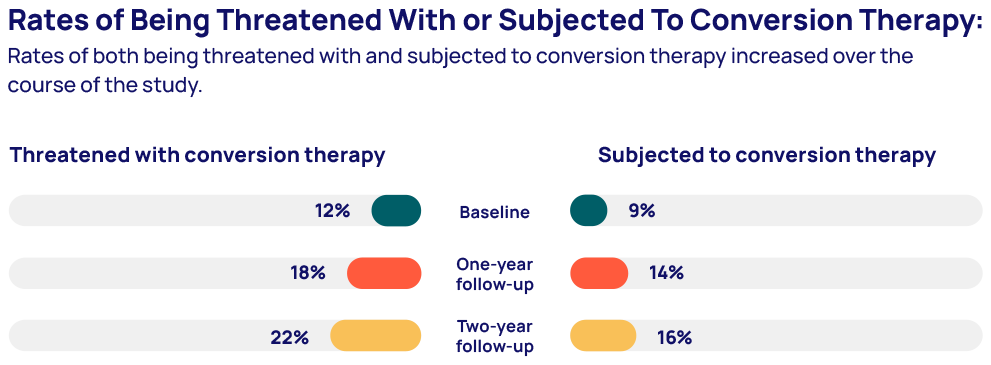
Threats of conversion therapy: At baseline, 12% of participants reported ever being threatened with conversion therapy. This increased to 18% at the one-year follow-up and 22% at the two-year follow-up. Overall, the proportion of participants who had ever been threatened with conversion therapy increased significantly across the study period, with the largest increase occurring during the first year.
Exposure to conversion therapy: At baseline, 9% of participants reported ever being subjected to conversion therapy. This increased to 14% at the one-year follow-up and 16% at the two-year follow-up. Overall, the proportion of participants who had ever been subjected to conversion therapy increased significantly across the study period, with the largest increase occurring during the first year.
Because these measures capture lifetime experiences, the increases indicate that threats of and exposure to conversion therapy continued to accumulate among participants over the two-year study period.
Economic Security
Economic security — defined here as houselessness and difficulty meeting basic needs such as food, housing, or clothing — showed the following patterns.
Houselessness
At baseline, 21% of participants reported having ever experienced houselessness. Follow-up surveys assessed whether participants had experienced houselessness in the past year. Among these follow-up surveys, past-year houselessness increased significantly from 7% at the one-year follow-up to 13% at the two-year follow-up.
Unmet basic needs
At baseline, 13% of participants reported being unable to meet their basic needs. Follow-up surveys assessed whether participants had been unable to meet their basic needs in the past year. At the one-year follow-up, 18% reported unmet basic needs in the past year, and at the two-year follow-up, 19% reported unmet basic needs in the past year. Overall, reports of unmet basic needs changed significantly across the study period, with no statistically significant change from the one-year to two-year follow-up.
These findings indicate that economic insecurity remained a persistent concern across the two-year study period. The significant increase in past-year houselessness from the one-year to two-year follow-up is especially notable, suggesting that housing instability may have worsened for some participants during the second year of follow-up.

Note: Baseline reflects current unmet basic needs; one-year and two-year follow-up estimates reflect past-year unmet basic needs.
Bathroom Access and Gender Identity
Among TGNB participants, reports of being prevented or discouraged from using a bathroom that corresponded with their gender identity were common across the study period. At baseline, 33% of TGNB participants reported ever having experienced this. Follow-up surveys assessed whether participants had been prevented or discouraged from using a bathroom that corresponded with their gender identity in the past year: 35% of TGNB participants reported being prevented or discouraged from using a bathroom that corresponded with their gender identity at the one-year follow-up, and 40% reported this at the two-year follow-up. Although a higher proportion of TGNB participants reported past-year bathroom access barriers at the two-year follow-up than at the one-year follow-up, this change was not statistically significant.

Note: Baseline reflects lifetime experience of being prevented or discouraged from using a bathroom that corresponded with one’s gender identity; one-year and two-year follow-up estimates reflect past-year experiences.
Table of Contents
Executive Summary
Background
Key Domains Measured
Results
• Demographics
• Changes in Mental Health Outcomes Over Time
• Changes in Risk Factors Over Time
• Changes in Protective Factors Over Time
• Temporal Relationships
Interpretations and Implications
Recommendations and Next Steps
References

Recommended Citation
Nath, R., Matthews, D.D., Hobaica, S., Eden, T.M., DeChants, J.P., Taylor, A.B., Suffredini, K. (2026). Project SPARK Two-Year Findings: A Longitudinal Study of Risk and Protective Factors in LGBTQ+ Youth Mental Health (2023-2026). West Hollywood, California: The Trevor Project. https://doi.org/10.70226/VFKG1732
For more information please contact: [email protected]
© The Trevor Project 2026