- Who We Are
- What We Do
- Crisis ServicesWe provide counseling support for LGBTQ+ young people 24/7, all year round
- Peer SupportWe provide an affirming international community for LGBTQ+ young people
- AdvocacyWe work to change hearts, minds, and laws in support of young LGBTQ+ lives
- Public EducationWe help allies and educators understand the needs of LGBTQ+ young people
- ResearchWe conduct research studies to equip policymakers and other LGBTQ+ youth-facing professionals
- Get Involved
- Support Us
- DonateSupport The Trevor Project Today
- FundraiseTap into your network and help us change the world
- Donor CommunityJoin the community of committed donors shining the way to our vision
- Commemorative GivingMake a tribute gift, leave a legacy, or create a memorial fundraiser in honor of a loved one
- StoreGet Trevor merch and show support for LGBTQ+ young people in your community
- Resources
- BlogRead about our community, supporters, and initiatives
- Media & CreatorsFind the latest news to support your coverage and content
- Research BriefsGet the latest research and clinical implications related to LGBTQ+ youth and suicide risks
- Breathing ExerciseTry this calming exercise that will help you relax and focus
- Mental Health SurveyUnderstand the mental health of LGBTQ+ young people
- Resource CenterExplore resources for allyship, sexual orientation, gender identity, mental health, and many more
Project SPARK Two-Year Findings: A Longitudinal Study of Protective and Risk Factors in LGBTQ+ Youth Mental Health
Results: Changes in Protective Factors Over Time
Observed changes in the rates of access to mental health care, affirming environments, social supports for gender transition, family support, and help-seeking over a two-year period.

Protective factors are the resources and supports that buffer minority stress and promote LGBTQ+ young people’s well-being. In this section, we examine how key protective factors changed over two years of Project SPARK, including access to mental health care; medical, legal, and social supports for gender transition (such as transgender health care and document updates); affirming environments (at home and in school); online safety; gender euphoria; and help-seeking behaviors.
Access to Mental Health Care
Access to Desired Mental Health Care
At the time of the baseline survey, among participants who wanted mental health care, 80% reported that they were receiving it. At the one-year follow-up, 61% reported receiving the mental health care they wanted in the past year. By the two-year follow-up, 80% reported receiving the mental health care they wanted in the past year. Overall, receipt of desired mental health care changed significantly across the study period; the follow-up estimates suggest that receipt of desired mental health care improved between the first and second years of follow-up, with the two-year follow-up estimate similar to the percentage reporting current receipt of care at baseline.

Note: Baseline reflects whether participants were receiving desired mental health care at the time of the survey; one-year and two-year follow-up estimates reflect receipt of desired mental health care in the past year.
Helpfulness of Received Mental Health Care
Among participants who received mental health care, most reported that the care was helpful. At baseline, 64% of participants who were receiving mental health care at the time of the survey reported that it was helpful. At the one-year follow-up, 80% of participants who received mental health care in the past year reported that it was helpful. By the two-year follow-up, 91% of participants who received mental health care in the past year reported that it was helpful. Overall, perceived helpfulness of received mental health care changed significantly across the study period, suggesting that participants who received care reported helpful care at increasingly higher rates over time.


Mental Health-Related Hospitalization
At baseline, 22% of participants reported ever having been hospitalized for mental health-related reasons. Follow-up surveys assessed past-year hospitalization. At the one-year follow-up, 5% of participants reported a mental health-related hospitalization in the past year, compared to 6% at the two-year follow-up. Rates of past-year hospitalization remained relatively low at both follow-up points and did not significantly change from the one-year to two-year follow-up.
Barriers to Care
Baseline Characteristics: At the start of the study, the most common reasons for being unable to access desired mental health care in the past were:
1. Inability to afford it (43%)
2. Fear of not being taken seriously (35%)
3. Fear of involuntary hospitalization (32%)
4. Fear of talking about mental health with someone else (31%)
5. Previous negative experiences with a therapist (30%).
Changes Over Time: Two years later, three of the five most common barriers reported at baseline remained among the top reasons for not accessing care:
1. Not wanting to have to get a parent/caregiver’s permission (49%)
2. Inability to afford care (27%)
3. Fear of talking about mental health with someone else (16%)
4. Fear of not being taken seriously (14%)
5. Feeling that provider would not understand their LGBTQ+ identity (13%)

Access to Transgender Health Care
Access to Puberty Blockers
Use of puberty blockers remained low across the two-year study period. At baseline, 2% of TGNB participants reported having ever used puberty blockers or using them at the time of the survey. At the one-year follow-up, 4% reported using puberty blockers during the past year; this remained at 4% at the two-year follow-up. Overall, reported puberty blocker use did not change significantly over the two-year follow-up period.

Access to Hormones
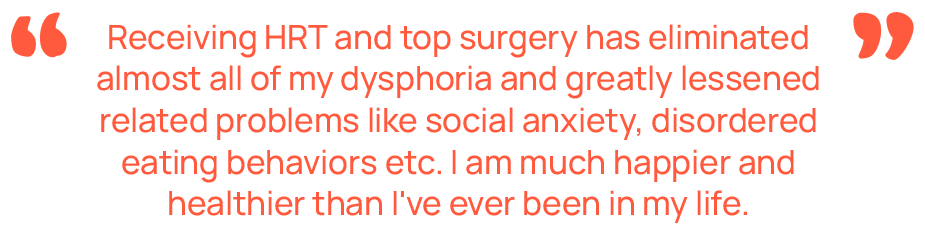
TGNB participants were asked whether they wanted gender-affirming hormones — also referred to as hormone replacement therapy — which typically include testosterone or estrogen used to support gender-related physical changes. The proportion of TGNB participants who wanted hormones increased significantly over the study period, from 59% at baseline to 67% at the one-year follow-up and 71% at the two-year follow-up. The increase from the one-year to two-year follow-up was not statistically significant.

Access to desired hormones also increased significantly across the two-year study period. Among TGNB participants who wanted hormones, 34% reported access at baseline, compared to 49% at the one-year follow-up and 62% at the two-year follow-up.
Because participants aged over the course of the study, age at follow-up is an important context for interpreting access to desired hormones. At the two-year follow-up, among TGNB participants who wanted hormones, 73% of those ages 18 and older had access to them, compared to 33% of those under age 18. Among TGNB participants who wanted hormones but did not have access at baseline, 37% had access by the end of the second study year. Among those who already had access to hormones at baseline, 97% maintained access by the two-year follow-up.


Access to Gender-Related Surgeries to Support Gender Transition
In the U.S., gender-related surgeries – when pursued – are undertaken after careful clinical evaluation and informed consent with qualified medical professionals, in line with applicable standards of care and laws. Availability and eligibility vary by age, state, and insurance. As with all findings in this report, these results are based on a convenience (non-probability) sample and are not nationally representative population estimates.
Among TGNB participants, reports of having had surgery in the past year increased from 2% at the one-year follow-up to 8% at the two-year follow-up; this change was statistically significant. Because participants aged over the course of the study, age at follow-up is an important context for interpreting the proportion of participants who reported having gender-related surgery in the past year. Nearly all participants who reported having surgery in the past year were ages 18 or older at the time of the survey. Among those who reported surgery during the second year of the study, the median age was 23 years old.
Access to Tools Related to Gender Expression or Transition
TGNB youth were asked whether they were able to access tools – such as clothing, binders, or shapewear – that support their gender expression or transition. Among TGNB participants who expressed interest in tools related to gender expression or transition, access increased significantly over the study period. At baseline, 62% reported being able to access tools they wanted. At the one-year follow-up, 68% reported having access to desired tools, increasing to 75% at the two-year follow-up.
Access to tools increased for both younger and older TGNB participants, though older participants reported higher levels of access overall. Among participants ages 18 and older at the time of the survey, access increased from 69% at baseline to 77% at the two-year follow-up. Among participants under age 18 at the time of the survey, access increased from 51% at baseline to 67% at the two-year follow-up, representing a larger increase among younger participants.

Ability to Change Identification Documents
TGNB participants were asked whether they wanted to change their identification documents, such as a driver’s license or passport, to match their gender identity, and whether they were able to do so. The proportion of TGNB participants who wanted to change their identification documents remained stable at about two-thirds across the study period (69% at baseline, 68% at the one-year and two-year follow-ups). Among those who wanted to change their documents, 55% reported being able to do so at baseline, compared to 58% at the one-year follow-up and 53% at the two-year follow-up.
Neither the proportion of TGNB participants who wanted to change their identification documents nor the proportion of those interested who were able to do so changed significantly across the two-year study period.
Affirming Spaces
Access to Affirming Schools
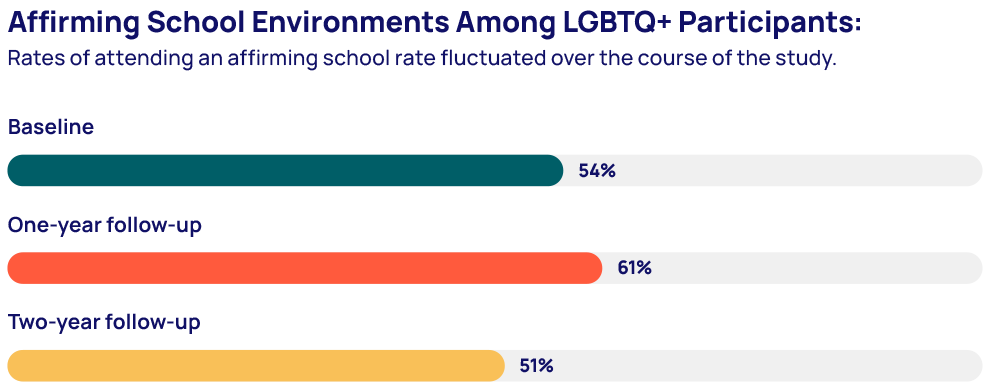
Among participants who were in school, 54% reported that their school was LGBTQ+-affirming at baseline. At the one-year follow-up, 61% reported having an LGBTQ+-affirming school environment, suggesting an increase in reported school affirmation during the first year. At the two-year follow-up, the percentage reporting an affirming school environment decreased to 51%. The distribution of reported affirming school environments differed significantly across the study period.

Access to Affirming Home Environments
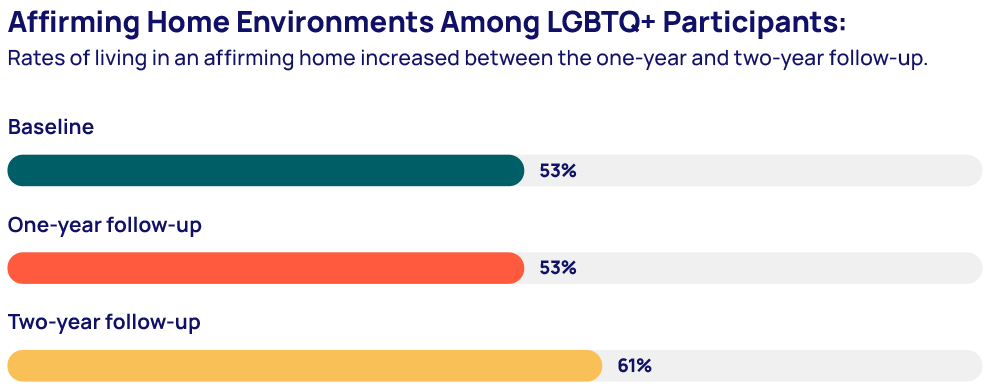
The percentage of LGBTQ+ young people who reported living in an LGBTQ+-affirming home environment increased over the two-year study period. At baseline, 53% of participants reported that their home was LGBTQ+-affirming. At the one-year follow-up, this remained similar, with 53% reporting an affirming home environment. At the two-year follow-up, this increased to 61%. Overall, the change across the study period was statistically significant, driven by the increase from the one-year to the two-year follow-up. These findings suggest that home environments became more affirming for some participants over time, particularly during the second year of follow-up.
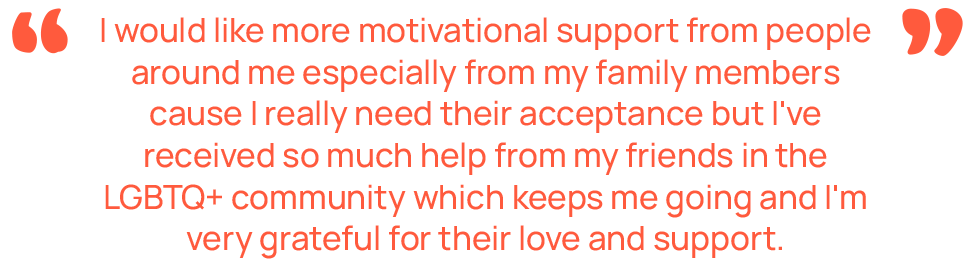
Types of Support Received by Family
LGBTQ+ youth answered 12 questions about specific family supportive actions (e.g., “Supported your gender expression,” “Talked with you respectfully about your LGBTQ+ identity”). Responses were on a 4-point scale (1 = no family members engaged in the action and 4 = all of the family members engaged in the action). Scores were summed to create a total score of supportive actions taken by the family.
Mean family supportive action scores changed significantly over the two-year study period. At baseline, when participants reported whether family members had ever engaged in each supportive action, the average score was 1.97 (standard deviation [SD] = 0.64, range: 1–4). At the one-year follow-up, when participants reported family supportive actions in the past year, the average score decreased to 1.87 (SD = 0.67). At the two-year follow-up, the average score increased slightly to 1.92 (SD = 0.76), though the change from the one-year to two-year follow-up was not statistically significant. Across all three time points, average scores remained close to 2 on the 1-4 scale, indicating that, on average, participants reported that some family members engaged in supportive actions across the study period.
Online Safety and Social Media Use
Measures of online safety and social media use were added at the one-year follow-up; therefore, changes are presented from the one-year to two-year follow-up only. On the Comfort Online Scale (Lucero, 2017), measured on a 1-5 scale where higher scores indicate greater comfort using social media to disclose personal information and explore or express gender and sexuality, the average score decreased from 3.53 (SD = 0.89) at the one-year follow-up to 3.43 (SD = 1.01) at the two-year follow-up. This modest decrease suggests that participants became slightly less comfortable using social media for personal disclosure and identity exploration during the second year of follow-up.
LGBTQ+-related cyberbullying was assessed using an adaptation of the Experiences and Frequency of Cyberbullying Subscale from the Cyberbullying and Face-to-Face Bullying Scale (Cooper & Blumenfeld, 2012). Scores ranged from 1 to 4, with higher scores indicating more frequent online harassment, exclusion, or harmful messages because a participant is LGBTQ+. The average LGBTQ+-cyberbullying scores at both time points were low, and decreased from 1.39 (SD = 0.60) at the one-year follow-up to 1.34 (SD = 0.56) at the two-year follow-up. This slight decrease suggests that participants reported marginally fewer LGBTQ+-related cyberbullying experiences during the second year of follow-up.
Participants were also asked about LGBTQ+-related social media behaviors in the past 30 days. From the one-year to two-year follow-up, participants reported modest decreases in LGBTQ+-related information-seeking, support-seeking, and connection on social media, including looking for information about sexual orientation or gender identity they would not ask about offline (47% to 45%), seeking LGBTQ+-related support (43% to 41%), and receiving affirming support online (38% to 33%).
Gender Euphoria
Gender euphoria captures how affirmed and comfortable young people feel in expressing their gender and being recognized for who they are. Following the Trans Youth CAN! Guide (Bauer et al., 2021), each participant’s score was calculated as the average of 10 items rated 1–5, yielding a 1–5 scale in which higher values indicate greater gender positivity.
Gender euphoria scores increased significantly over the two-year study period. Among all LGBTQ+ participants, the average gender positivity score increased from 3.09 (SD = 0.82) at baseline to 3.24 (SD = 0.85) at the one-year follow-up and 3.33 (SD = 0.85) at the two-year follow-up. This represents a 0.24-point increase from baseline to the two-year follow-up. Among TGNB participants, the average score increased from 3.07 (SD = 0.83) at baseline to 3.23 (SD = 0.85) at the one-year follow-up and 3.37 (SD = 0.85) at the two-year follow-up. This represents a 0.30-point increase from baseline to the two-year follow-up. Both increases were statistically significant.
These findings indicate that, on average, participants reported feeling somewhat more affirmed and comfortable in their gender over time. Although the increases were modest in magnitude, they suggest a consistent upward pattern in gender positivity across the first two years of the study, including among TGNB participants.
Help-seeking behaviors during suicidal crises
Participants who experienced suicidal thoughts were asked whether they sought help from different sources during those suicidal crises. Across the two-year study period, friends were the most commonly reported source of support, followed by mental health professionals and intimate partners. Helplines were the only source of support that changed significantly across the study period.
Friends: Friends were the most common source of support across all time points. At baseline, 44% of participants who experienced suicidal thoughts reported seeking help from a friend, compared to 46% at the one-year follow-up and 42% at the two-year follow-up.
Mental health professionals: Help-seeking from a mental health professional remained relatively stable, reported by 35% at baseline, 38% at the one-year follow-up, and 37% at the two-year follow-up.
Intimate partners: Help-seeking from an intimate partner was reported by 31% at baseline, 37% at the one-year follow-up, and 32% at the two-year follow-up.
Helplines: Help-seeking from a helpline increased from 22% at baseline to 30% at the one-year follow-up and remained at 30% at the two-year follow-up. This was the only source of support that changed significantly across the study period.
Parents/caregivers and other family members: Help-seeking from a parent or caregiver was reported by 15% at baseline, 17% at the one-year follow-up, and 17% at the two-year follow-up. Help-seeking from another relative or family member was reported by 11% at baseline, 14% at the one-year follow-up, and 10% at the two-year follow-up.
Doctors/general practitioners: Help-seeking from a doctor or general practitioner remained low, reported by 6% at baseline, 4% at the one-year follow-up, and 5% at the two-year follow-up.
Religious leaders: Help-seeking from a minister or religious leader was rare across all time points, reported by 1% at baseline and less than 1% at both follow-ups.
No one: The proportion of participants who reported seeking help from no one when experiencing suicidal thoughts was 29% at baseline, 31% at the one-year follow-up, and 32% at the two-year follow-up.

Table of Contents
Executive Summary
Background
Key Domains Measured
Results
• Demographics
• Changes in Mental Health Outcomes Over Time
• Changes in Risk Factors Over Time
• Changes in Protective Factors Over Time
• Temporal Relationships
Interpretations and Implications
Recommendations and Next Steps
References

Recommended Citation
Nath, R., Matthews, D.D., Hobaica, S., Eden, T.M., DeChants, J.P., Taylor, A.B., Suffredini, K. (2026). Project SPARK Two-Year Findings: A Longitudinal Study of Risk and Protective Factors in LGBTQ+ Youth Mental Health (2023-2026). West Hollywood, California: The Trevor Project. https://doi.org/10.70226/VFKG1732
For more information please contact: [email protected]
© The Trevor Project 2026