- Who We Are
- What We Do
- Crisis ServicesWe provide counseling support for LGBTQ+ young people 24/7, all year round
- Peer SupportWe provide an affirming international community for LGBTQ+ young people
- AdvocacyWe work to change hearts, minds, and laws in support of young LGBTQ+ lives
- Public EducationWe help allies and educators understand the needs of LGBTQ+ young people
- ResearchWe conduct research studies to equip policymakers and other LGBTQ+ youth-facing professionals
- Get Involved
- Support Us
- DonateSupport The Trevor Project Today
- FundraiseTap into your network and help us change the world
- Donor CommunityJoin the community of committed donors shining the way to our vision
- Commemorative GivingMake a tribute gift, leave a legacy, or create a memorial fundraiser in honor of a loved one
- StoreGet Trevor merch and show support for LGBTQ+ young people in your community
- Resources
- BlogRead about our community, supporters, and initiatives
- Media & CreatorsFind the latest news to support your coverage and content
- Research BriefsGet the latest research and clinical implications related to LGBTQ+ youth and suicide risks
- Breathing ExerciseTry this calming exercise that will help you relax and focus
- Mental Health SurveyUnderstand the mental health of LGBTQ+ young people
- Resource CenterExplore resources for allyship, sexual orientation, gender identity, mental health, and many more
Project SPARK Two-Year Findings: A Longitudinal Study of Protective and Risk Factors in LGBTQ+ Youth Mental Health
Results: Temporal Relationships
Risk and protective factors and their associations with changes in mental health, suicide ideation, and self-harm over a two-year period.

Risk and protective factors were associated with changes in participants’ likelihood of experiencing recent symptoms of anxiety, recent symptoms of depression, self-harm, and suicidal ideation over time. All models accounted for the nested nature of the data, in which multiple observations from the same participant were collected across waves. Models also controlled for age, sexual orientation, gender identity, and race/ethnicity.
Also, not described earlier, we examined the effects of high social support as a protective factor for the outcomes we look at below. Friend and family support were operationalized using an abridged version of the Multidimensional Scale of Perceived Social Support (MSPSS). Participants were categorized as having high support if they scored above 5 (“mildly agree” or higher) on the 1–7 response scale. Descriptive percentages at baseline and follow-up are not shown here because analyses focused on this dichotomized “high support” measure, which was used consistently across all models.
Risk Factors
Several risk factors were consistently associated with higher likelihood of adverse mental health outcomes, self-harm, and suicidal ideation. The largest observed associations included:
• Participants who had been threatened with or subjected to conversion therapy had nearly three times the odds of suicidal ideation over time (aOR = 2.86, 95% CI = 2.28–3.60).
• Participants who experienced houselessness had more than twice the odds of self-harm (aOR = 2.29, 95% CI = 1.75–2.98) and suicidal ideation (aOR = 2.33, 95% CI = 1.85–2.95).
• Among TGNB participants, victimization based on gender identity was associated with more than twice the odds of self-harm (aOR = 2.21, 95% CI = 1.80–2.72) and suicidal ideation (aOR = 2.42, 95% CI = 1.96–2.98).
• Recent mental health-related hospitalization showed the strongest association with self-harm (aOR = 5.90, 95% CI = 3.85–9.03).
The full set of associations for each of the risk factors is presented below.
Victimization based on sexual orientation was associated with higher likelihood of anxiety symptoms (adjusted odds ratio [aOR] = 1.24, 95% confidence interval [CI] = 1.10–1.46), depressive symptoms (aOR = 1.42, 95% CI = 1.21–1.66), self-harm (aOR = 1.71, 95% CI = 1.41–2.07), and suicidal ideation over time (aOR = 1.73, 95% CI = 1.45–2.06).
Victimization based on gender identity was associated with higher likelihood of anxiety symptoms (aOR = 1.77, 95% CI = 1.44–2.18), depressive symptoms (aOR = 1.52, 95% CI = 1.25–1.85), self-harm (aOR = 2.21, 95% CI = 1.80–2.72), and suicidal ideation over time (aOR = 2.42, 95% CI = 1.96–2.98).
Discrimination based on sexual orientation was associated with higher likelihood of depressive symptoms (aOR = 1.42, 95% CI = 1.23–1.65), self-harm (aOR = 1.28, 95% CI = 1.08–1.51), and suicidal ideation over time (aOR = 1.50, 95% CI = 1.28–1.77).
Discrimination based on gender identity was associated with higher likelihood of anxiety symptoms (aOR = 1.47, 95% CI = 1.22–1.77), depressive symptoms (aOR = 1.48, 95% CI = 1.24–1.78), self-harm (aOR = 1.46, 95% CI = 1.21–1.77), and suicidal ideation over time (aOR = 1.48, 95% CI = 1.22–1.79).
Having been threatened with or subjected to conversion therapy was associated with higher likelihood of anxiety symptoms (aOR = 1.28, 95% CI = 1.04–1.58), depressive symptoms (aOR = 1.59, 95% CI = 1.30–1.95), self-harm (aOR = 1.80, 95% CI = 1.39–2.31), and suicidal ideation over time (aOR = 2.86, 95% CI = 2.28–3.60).
Houselessness was associated with higher likelihood of anxiety symptoms (aOR = 1.32, 95% CI = 1.06–1.65), depressive symptoms (aOR = 1.41, 95% CI = 1.14–1.75), self-harm (aOR = 2.29, 95% CI = 1.75–2.98), and suicidal ideation over time (aOR = 2.33, 95% CI = 1.85–2.95).
Being unable to meet basic needs was associated with higher likelihood of anxiety symptoms (aOR = 1.60, 95% CI = 1.30–1.97), depressive symptoms (aOR = 1.82, 95% CI = 1.50–2.23), self-harm (aOR = 1.74, 95% CI = 1.39–2.16), and suicidal ideation over time (aOR = 1.65, 95% CI = 1.33–2.03).
Among TGNB participants, being prevented from using a bathroom that corresponded with their gender identity was associated with higher likelihood of anxiety symptoms (aOR = 1.33, 95% CI = 1.07–1.66), depressive symptoms (aOR = 1.55, 95% CI = 1.26–1.91), self-harm (aOR = 1.77, 95% CI = 1.42–2.21), and suicidal ideation over time (aOR = 1.47, 95% CI = 1.18–1.84).
Recent mental health-related hospitalization was associated with higher likelihood of anxiety symptoms (aOR = 1.57, 95% CI = 1.10–2.22), self-harm (aOR = 5.90, 95% CI = 3.85–9.03), and suicidal ideation over time (aOR = 1.43, 95% CI = 1.02–1.99).
Protective Factors
Several protective factors were associated with lower likelihood of adverse mental health outcomes, self-harm, and suicidal ideation. Some protective associations were also especially notable, including:
• Higher family support was associated with 45% lower odds of suicidal ideation (aOR = 0.55, 95% CI = 0.48–0.64) and 42% lower odds of self-harm (aOR = 0.58, 95% CI = 0.50–0.67).
• Higher gender euphoria was associated with 50% lower odds of suicidal ideation (aOR = 0.50, 95% CI = 0.44–0.57) and 49% lower odds of depressive symptoms (aOR = 0.51, 95% CI = 0.45–0.58).
• Among TGNB participants, being able to change identification documents to match one’s gender identity was associated with 45% lower odds of suicidal ideation (aOR = 0.55, 95% CI = 0.43–0.72), and access to desired hormones was associated with 38% lower odds of depressive symptoms (aOR = 0.62, 95% CI = 0.46–0.85).
The full set of associations for each of the protective factors is presented below.
Among TGNB participants, being able to change identification documents to match one’s gender identity was associated with lower likelihood of anxiety symptoms (aOR = 0.69, 95% CI = 0.53–0.89), depressive symptoms (aOR = 0.69, 95% CI = 0.54–0.89), and suicidal ideation over time (aOR = 0.55, 95% CI = 0.43–0.72).
Among TGNB participants, access to desired hormones was associated with lower likelihood of depressive symptoms (aOR = 0.62, 95% CI = 0.46–0.85) and suicidal ideation over time (aOR = 0.65, 95% CI = 0.47–0.91).
Living in an LGBTQ+-affirming home was associated with lower likelihood of anxiety symptoms (aOR = 0.78, 95% CI = 0.67–0.90), depressive symptoms (aOR = 0.63, 95% CI = 0.55–0.73), self-harm (aOR = 0.70, 95% CI = 0.59–0.82), and suicidal ideation over time (aOR = 0.76, 95% CI = 0.65–0.89).
Family support was associated with lower likelihood of anxiety symptoms (aOR = 0.73, 95% CI = 0.64–0.83), depressive symptoms (aOR = 0.59, 95% CI = 0.52–0.68), self-harm (aOR = 0.58, 95% CI = 0.50–0.67), and suicidal ideation over time (aOR = 0.55, 95% CI = 0.48–0.64).
Gender euphoria was associated with lower likelihood of anxiety symptoms (aOR = 0.58, 95% CI = 0.52–0.66), depressive symptoms (aOR = 0.51, 95% CI = 0.45–0.58), self-harm (aOR = 0.70, 95% CI = 0.62–0.79), and suicidal ideation over time (aOR = 0.50, 95% CI = 0.44–0.57).
Taken together, the models show that experiences of victimization, discrimination, conversion therapy, economic insecurity, bathroom access barriers, and recent hospitalization were associated with greater likelihood of adverse mental health outcomes, self-harm, and suicidal ideation over time. In contrast, affirming home environments, family support, and gender euphoria were consistently associated with lower likelihood of anxiety, depression, self-harm, and suicidal ideation, while access to gender-affirming resources — including accurate identification documents and desired hormones — was associated with lower likelihood of anxiety, depression, and/or suicidal ideation among TGNB participants.

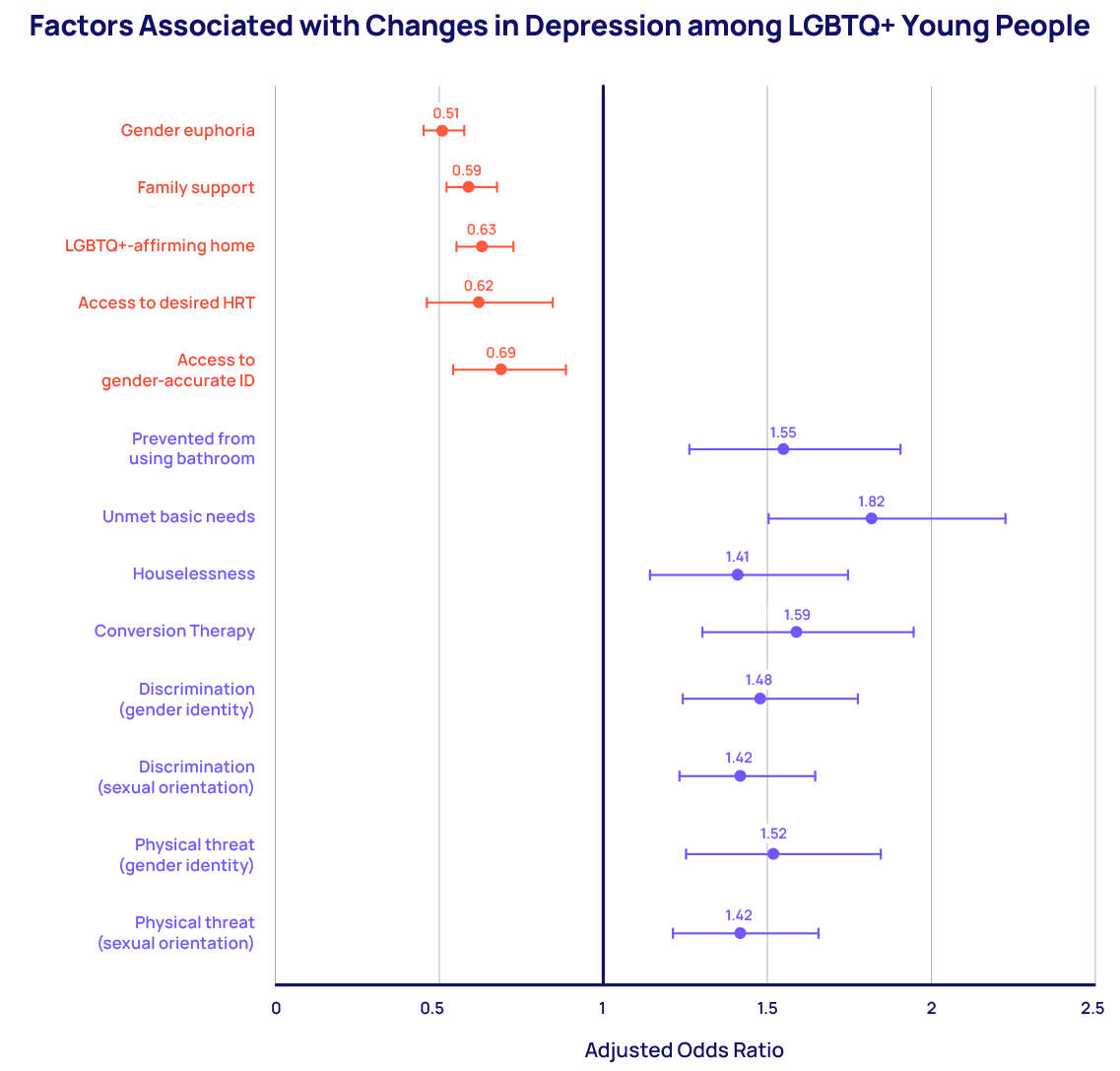

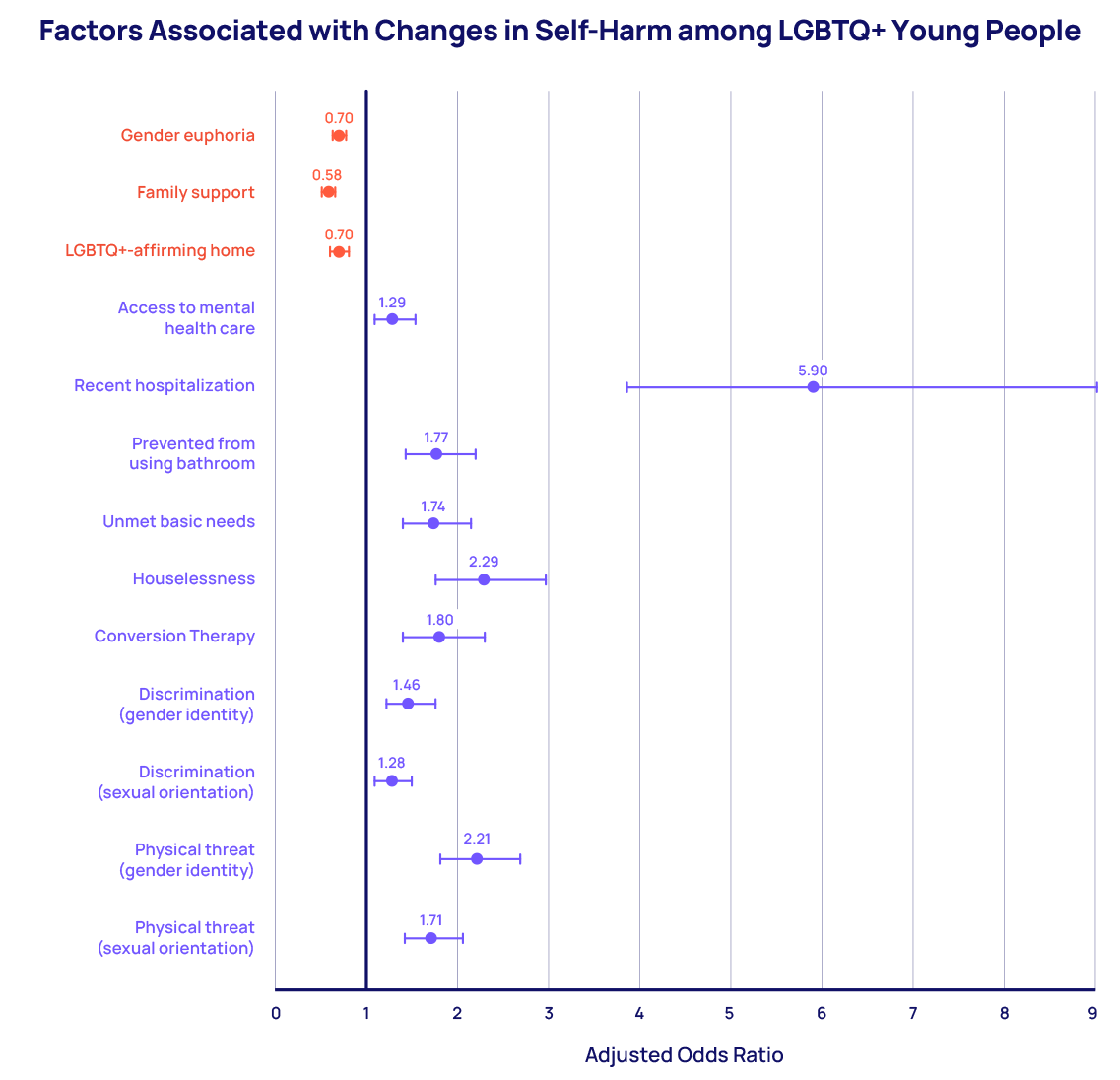
Table of Contents
Executive Summary
Background
Key Domains Measured
Results
• Demographics
• Changes in Mental Health Outcomes Over Time
• Changes in Risk Factors Over Time
• Changes in Protective Factors Over Time
• Temporal Relationships
Interpretations and Implications
Recommendations and Next Steps
References

Recommended Citation
Nath, R., Matthews, D.D., Hobaica, S., Eden, T.M., DeChants, J.P., Taylor, A.B., Suffredini, K. (2026). Project SPARK Two-Year Findings: A Longitudinal Study of Risk and Protective Factors in LGBTQ+ Youth Mental Health (2023-2026). West Hollywood, California: The Trevor Project. https://doi.org/10.70226/VFKG1732
For more information please contact: [email protected]
© The Trevor Project 2026